MONOGUITARBAG Team

How to Pack a Guitar for Air Travel: Hard Case vs Gig Bag

Flying with a guitar is stressful. Airlines vary, instruments are precious, and baggage handlers are not gentle. Here is what actually protects a guitar in the air. Check-in vs carry-on Small guitars (3/4 size or travel guitars) can sometimes fit overhead. Full-size dreadnoughts almost always go in the hold. Always confirm with your airline before

How to Pack a Guitar for Air Travel: Hard Case vs Gig Bag Read More »
Guitar Case Interior: Why Suspension Systems Matter

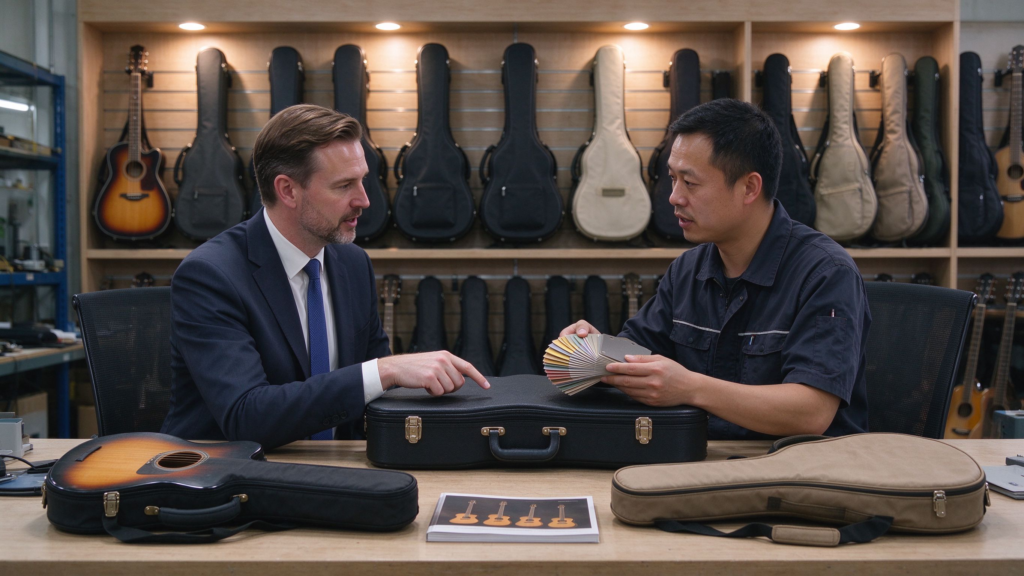
Suspension-style interiors hold the guitar off the case walls. That gap absorbs shock that solid cradles transfer directly. How suspension works The guitar sits on foam blocks or straps, with clearance around the body. Impact on the shell flexes before touching the instrument. Why it matters Dropped cases: impact absorbed before the body. Expansion room:

Guitar Case Interior: Why Suspension Systems Matter Read More »

PU Leather vs Genuine Leather for Guitar Bags: An OEM Material Comparison

Leather remains the most premium material perception in guitar bags. But for OEM production, PU leather has become the industry standard for good reasons. Here is an honest comparison. PU Leather (Synthetic) Consistent color and texture, lower cost, easier to maintain, animal-friendly, and available in any finish from smooth to distressed. Our 1062 series PU

PU Leather vs Genuine Leather for Guitar Bags: An OEM Material Comparison Read More »

Mandolin Cases: A-Style vs F-Style Fit Guide

Mandolins come in two body styles that need different case shapes. Fit mistakes are common and costly. A-style mandolins Teardrop body, no scroll. Slimmer and simpler. Fit A-style specific cases or padded bags. F-style mandolins Scrolled body, ornate. Need F-style shaped interiors — the scroll must seat correctly or the case will not close. Check

Mandolin Cases: A-Style vs F-Style Fit Guide Read More »

Electric Guitar Case Buying Guide for OEM Buyers: ABS, Wood and Carbon

Electric guitars are the biggest case category by volume. Here is how OEM buyers should structure an electric case line across three material families. ABS Molded (Volume) Injection-molded ABS covers the mass market: durable, waterproof, low price. Standard features – plush interior, one accessory pocket, secure latches. This is 60-70% of the market. Wood /

Electric Guitar Case Buying Guide for OEM Buyers: ABS, Wood and Carbon Read More »

Electric Guitar Gig Bags: Thickness Guide by Use Case

Padding thickness is the first number buyers ask about. Here is how much padding you actually need. By use case Home/studio (5mm): dust protection only. Local gigs (10mm): standard gigging. Train/car travel (15mm+): bump protection. Premium (20mm+): near semi-hard protection. How padding is measured Foam thickness in mm, often on both walls. Ask for the

Electric Guitar Gig Bags: Thickness Guide by Use Case Read More »

Custom Guitar Bag Design: Fabrics, Padding and Branding Options

Designing a custom guitar bag for your brand is about more than choosing a color. The three decisions that matter most are fabric, padding and branding — and each affects both cost and customer perception. Fabrics. PU leather delivers a premium, upscale look that photographs well. Tweed offers vintage character. Nylon and polyester give lightweight

Custom Guitar Bag Design: Fabrics, Padding and Branding Options Read More »

Guitar Case OEM: A Complete Guide for Brands Working with Chinese Factories

OEM with Chinese factories is a proven model, but the details decide whether it works. This guide covers the full process. Step 1: Brief your factory Send drawings, CAD files or a target sample with your spec list: dimensions, materials, hardware, colors, logo, packaging. Step 2: Tooling and samples New molds take 15-30 days. Pay

Guitar Case OEM: A Complete Guide for Brands Working with Chinese Factories Read More »